Gamefowl brooding, wing-banding and vaccination: day 1 to day 90
Brooder temperatures, wing-banding steps and the ND schedules published by the DA and BAI.
A chick’s first weeks shape the rest of its life. This guide covers brooder temperature, how to read chick behaviour, wing-banding for pedigree records, and the vaccination schedules the Philippine government has published, with every number linked to its source.
Brooder temperature: week by week
Mississippi State University Extension recommends setting the brooder to 90–95 °F (about 32–35 °C) at the outer edge of the heat source for the first week, then lowering it by about 5 °F (about 3 °C) each week until the chicks are feathered and comfortable at room temperature.
| Chick age | Temperature at brooder edge |
|---|---|
| Week 1 | 90–95 °F (32–35 °C) |
| Week 2 | about 85–90 °F (29–32 °C) |
| Week 3 | about 80–85 °F (27–29 °C) |
| Week 4 | about 75–80 °F (24–27 °C) |
| Week 5 onward | about 70–75 °F (21–24 °C), or ambient once fully feathered |
Weeks 2–5 apply the 5 °F weekly step to the week-1 range. In the Philippines, daytime temperatures often exceed these targets, so heat may only be needed at night. Use a thermometer at chick height.
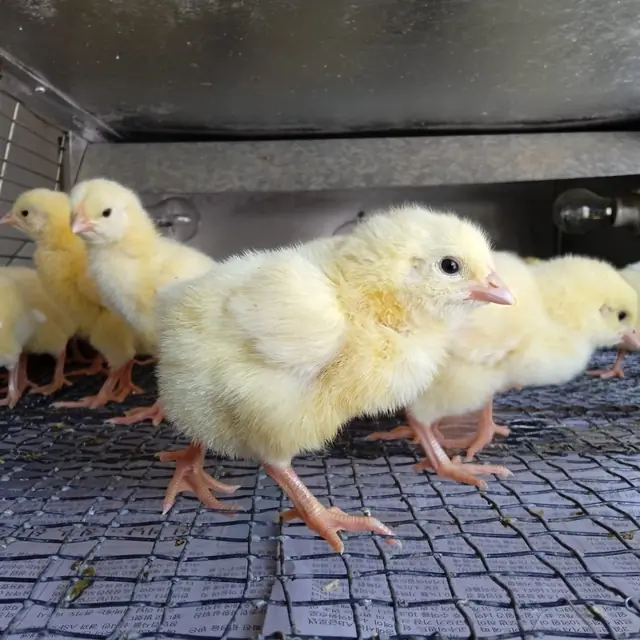
Let the chicks tell you
- Huddled under the heat and cheeping loudly: too cold or draughty.
- Crowded at the edges, panting, wings held out: too hot.
- Bunched on one side: a draught or uneven heat.
- Spread evenly, eating, drinking and resting: about right.
Feed a complete chick starter or booster at the rate on the bag, with clean water from day one.
Wing-banding at hatch
If you breed more than one pen, band chicks before chicks from different hens are mixed, so your pedigree records stay accurate.
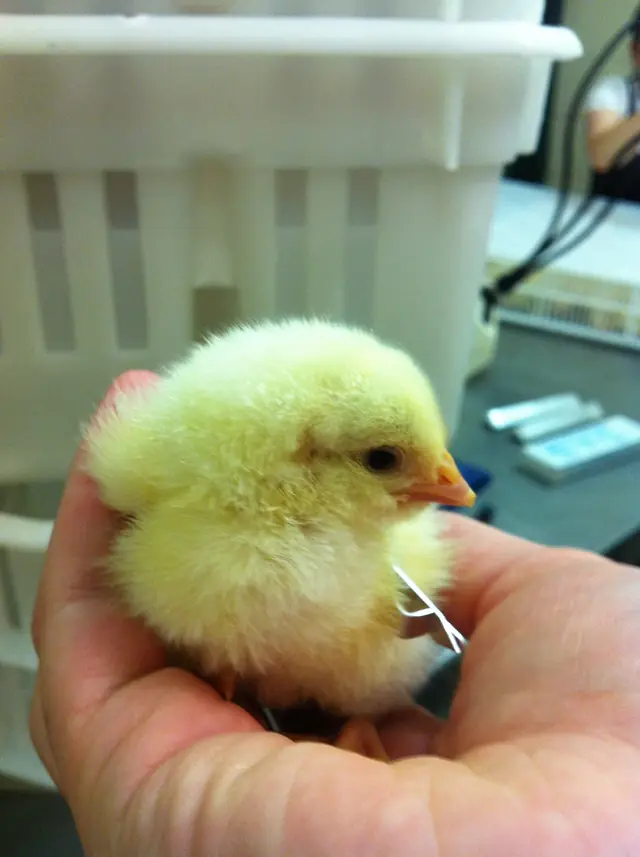
- Wash your hands and keep the band applicator clean.
- Hold the chick gently and stretch the wing to find the thin web of skin at the front edge (the propatagium).
- Pass the band through the web only, avoiding the bone, the muscle and visible blood vessels, and close it so it can’t snag.
- Record the band number with the sire, dam, pen and hatch date straight away.
- Check bands as chicks grow. Most breeders later move to leg bands or larger wing bands.
Some breeders also use their own codes, such as a particular wing or band colour for each pen. Whatever system you use, write it down. If you’re unsure about technique, ask your veterinarian or an experienced breeder to show you first.
Where to buy (coming soon) What to look for in wing bands
Vaccination: what the government schedules say
Newcastle disease (ND) is the vaccine every Philippine source puts first. The Department of Agriculture says there is no treatment for it and that vaccination is the best prevention, especially for backyard poultry and gamefowl.
DA minimum ND schedule for gamefowl and free-range chickens
| Age | Vaccine | Route |
|---|---|---|
| Day 1–3 | ND live (B1B1 or La Sota) | Eye or nose drop |
| Day 10–14 | ND live (La Sota) | Eye or nose drop |
| Day 28 | ND live (La Sota) | Eye or nose drop |
| Every 3 months after | ND live (La Sota) | Eye or nose drop |
Source: Department of Agriculture, Memorandum Circular No. 7, s. 2018, “ND Vaccination Guidelines for Poultry”. The DA calls this the minimum. A second government version, BAI Memorandum Circular No. 35, s. 2020, gives ND live at day 3–7, La Sota at day 14–17 and killed La Sota by injection at day 28. Ask your veterinarian which applies to your area.
Other vaccines to discuss with your vet
- Marek’s disease: given at the hatchery on day 1 (Merck Veterinary Manual), so ask your chick supplier whether it was done.
- Infectious bursal disease (Gumboro): live vaccines are given in the first weeks of life. Timing depends on the hens’ vaccination status.
- Fowl pox: given by wing-web puncture. Check for a “take” (a small swelling and scab) about a week later.
- Infectious coryza and fowl cholera: bacterins that only protect against the types they contain, so your vet will check what occurs locally.
Brand vaccination programmes add these at different ages. Where a brand programme and the government schedule disagree on ND, follow the government minimum and your vet.
Vaccine handling
- Keep live ND vaccine refrigerated at 4–8 °C, never frozen and never in sunlight (FAO/ACIAR field manual). Carry it home in a cooler with ice.
- Use a mixed vial straight away, and don’t keep it for the next day.
- Never mix live vaccine with chlorinated tap water.
- Vaccinate healthy birds only, and record the product, lot, expiry date, date given and bird ages.
For disease names and local terms, see gamefowl diseases and vaccination on SabongWiki.ph. Once chicks are banded and growing, plan pairings with the cross calculator.
Frequently asked questions
What temperature should a brooder be in week 1?
Mississippi State University Extension recommends about 90–95 °F (32–35 °C) at the edge of the brooder for the first week, lowered by about 5 °F (3 °C) each week. Watch the chicks: huddling under the heat means too cold, panting at the edges means too hot.
What is the minimum Newcastle disease schedule for gamefowl chicks?
The DA schedule for gamefowl and free-range chickens (Memorandum Circular No. 7, 2018) gives live ND vaccine by eye or nose drop at day 1–3, day 10–14 and day 28, then every three months. BAI Memorandum Circular No. 35 (2020) gives a slightly different program. Your veterinarian sets the final schedule.
When should chicks be wing-banded?
Many breeders band at hatch, before chicks from different hens are mixed, so the pedigree record stays accurate. Band through the loose skin web of the wing and avoid the bone and blood vessels.
- Mississippi State University Extension, “Brooding Chickens and Quail”: poultry.msstate.edu
- Department of Agriculture, Memorandum Circular No. 7, s. 2018, with attachment “ND Vaccination Guidelines for Poultry”; Bureau of Animal Industry, Memorandum Circular No. 35, s. 2020: bai.gov.ph issuances
- Merck Veterinary Manual: Vaccination Programs in Poultry, Marek’s Disease, Newcastle Disease, Infectious Bursal Disease
- Alders R. & Spradbrow P., Controlling Newcastle Disease in Village Chickens: A Field Manual (FAO/ACIAR)