Sweater × Kelso cross guide: genetics, looks and pairing direction
What a 50/50 Sweater × Kelso F1 is, what the written histories say, and what pairing direction does and doesn't change.
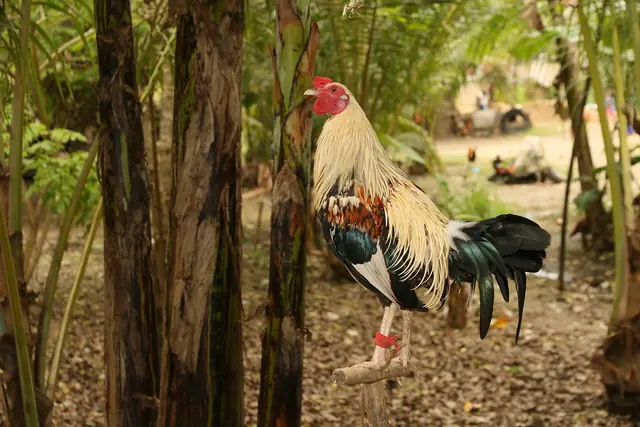
The Sweater × Kelso cross is one of the best-known first-generation (F1) pairings among Filipino gamefowl breeders. This guide covers what the cross is genetically, where the two lines come from (and where the stories disagree), whether it matters which line is the sire, and how to keep records so the cross stays traceable.
What a 50/50 Sweater × Kelso cross is
An F1 cross is the first generation from two different lines. Put a Sweater broodcock over a Kelso broodhen (or the reverse) and, on average, every chick carries half of each parent’s ancestry: 1/2 Sweater, 1/2 Kelso. That is why breeders call it a “50/50”.
“On average” matters. Each chick inherits a random half of each parent’s genes, so full siblings from the same pen can look and grow quite differently. Crossing two unrelated lines often brings hybrid vigour (heterosis), meaning better growth, hardiness or fertility than the average of the parents, but it isn’t guaranteed for every trait or every chick. Try the maths in our F1 cross calculator.
Where the two lines come from
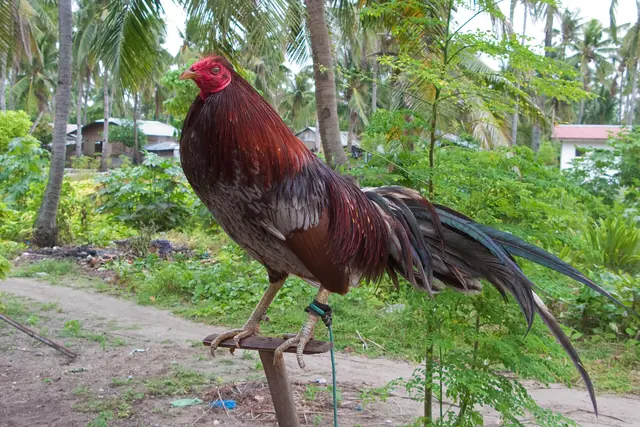
Gamefowl histories were passed on mostly by word of mouth and in breeders’ magazines, so accounts often differ. Here is what the written sources say.
Kelso
The Kelso line is named after the American breeder Walter Kelso, who, according to breeder histories, built it by crossing proven birds from other yards into his own stock. Breeders describe Kelsos as pea- or straight-combed with yellow or white legs. Several sub-families (often called “Out-and-Out” or by later breeders’ names) descend from his birds.
Sweater: three versions of the story
- The Johnny Jumper account (as retold on gamefowl history pages): “Sweater” McGinnis gave Walter Kelso a yellow-legged Hatch cock. Kelso bred it to his Kelso hens. Cecil Davis later bred one of those sons back to five out-and-out Kelso hens, and those chicks founded the Sweaters. That would make the original Sweaters roughly 3/4 Kelso, 1/4 yellow-legged Hatch, named after McGinnis because his Hatch cock was their grandsire.
- Carol NeSmith’s own account: NeSmith (Black Water Farms, Alabama) wrote that he bought a young trio from Odis Chappell, whose birds came from Sonny Ware, and that Johnny Jumper told him the McGinnis cocks were half Boston Roundhead and half McLean Hatch from Harold Brown. NeSmith says he didn’t originate the Sweater; he bred and refined it, and the line later did well in the Philippines and Mexico.
- The SabongWiki.ph summary describes McGinnis breeding a Kearney yellow-legged Hatch onto a half Law Grey, half Madigin Claret hen, refined later by NeSmith. See SabongWiki.ph foundation bloodline pedigrees.
The accounts agree that the Sweater carries Kelso and Hatch blood and that NeSmith’s refinement made it widely known. They disagree on the exact make-up, so treat any precise “recipe” with caution.
One practical point follows: if the Jumper account is right, a Sweater × Kelso cross is closer to a back-cross towards Kelso than a cross of two unrelated lines. How much hybrid vigour you see depends on how related your particular Sweater and Kelso families are.
Sweater sire or Kelso sire: does direction matter?
Breeders argue about “topside” (sire) and “bottomside” (dam) lines. Genetics gives a partial answer:
- For most genes, direction doesn’t matter. Genes on the ordinary (autosomal) chromosomes come half from each parent either way, so the blood fraction is 50/50 whichever line is the sire.
- Sex-linked genes are different. In chickens the male is ZZ and the female ZW. A hen passes her only Z chromosome to her sons, never to her daughters. Genes on the Z chromosome, such as the barring gene, therefore show up differently in sons and daughters depending on which way round you make the cross.
- Maternal effects are real but modest. Mitochondrial DNA comes only from the hen, and her health and nutrition affect egg quality and early chick vigour. That is one reason good broodhens are valued.
Beyond that, claims that one direction gives a particular style or maturity age are breeder experience rather than tested results, and they vary from yard to yard.
Comb and leg colour: what to expect
| Trait | Genetics | What you can expect in the F1 |
|---|---|---|
| Comb | Pea comb is dominant over straight (single) comb. It was traced to the SOX5 gene (Wright et al., 2009). | If either parent is pure-breeding pea, all chicks are pea-combed. If a pea parent carries straight, expect some straight combs. |
| Yellow vs white shanks | Yellow skin is recessive to white skin (Eriksson et al., 2008). | Yellow-legged × yellow-legged gives yellow-skinned chicks. A white-legged Kelso parent may give white shanks, or a mix if it carries yellow. |
| Green / willow shanks | Yellow skin plus dark pigment in the skin, which involves other genes. | Hard to predict from parents alone. |
Choosing breeders and keeping chicks traceable
- Select for health and soundness first: clear bright eyes, clean nostrils, straight keel and toes, good feathering, sound legs and a calm, alert temperament. Don’t breed from birds that have needed repeated treatment.
- Record everything: pen number, sire and dam band numbers, set date, hatch date and hatch rate per hen. Without records, a “50/50” is just a guess.
- Band at hatch before chicks from different hens are mixed. See our wing-banding steps.
Wing bands: where to buy (coming soon) See our wing band notes
Going further: three-way crosses
Many breeders use F1 hens as the base of a three-way cross. For example, F1 Hatch × Kelso pullets put under a Sweater cock give chicks that are 1/2 Sweater, 1/4 Kelso, 1/4 Hatch. Our Hatch guide walks through it, and the calculator handles three-way pedigrees.
For winners’ records where these lines appear, see the World Slasher Cup champions archive on SabongWiki.ph, and for terms like “broodcock”, “stag” and “bullstag”, the SabongWiki.ph sabong glossary.
- “History of Sweaters” (Johnny Jumper account), Your Daily Dose of Gamefowls: gamefowlactionsports.weebly.com
- Carol NeSmith, “Sweater”, reprinted on Gameness til the End: gtte.wordpress.com
- “Kelso”, DNA Hobby Farm breed history: dnahobbyfarm.com
- SabongWiki.ph, foundation bloodline pedigrees: sabongwiki.ph
- Wright D. et al. (2009) Copy number variation in intron 1 of SOX5 causes the Pea-comb phenotype in chickens. PLoS Genetics: doi.org/10.1371/journal.pgen.1000512
- Eriksson J. et al. (2008) Identification of the yellow skin gene reveals a hybrid origin of the domestic chicken. PLoS Genetics: doi.org/10.1371/journal.pgen.1000010